Reach Fell Off a Cliff: How to Tell a Shadowban From Everything Else
A reach collapse has four common causes and only one of them is suppression. Treating all four the same way is why so many accounts never recover. Here is how to tell them apart in an afternoon.
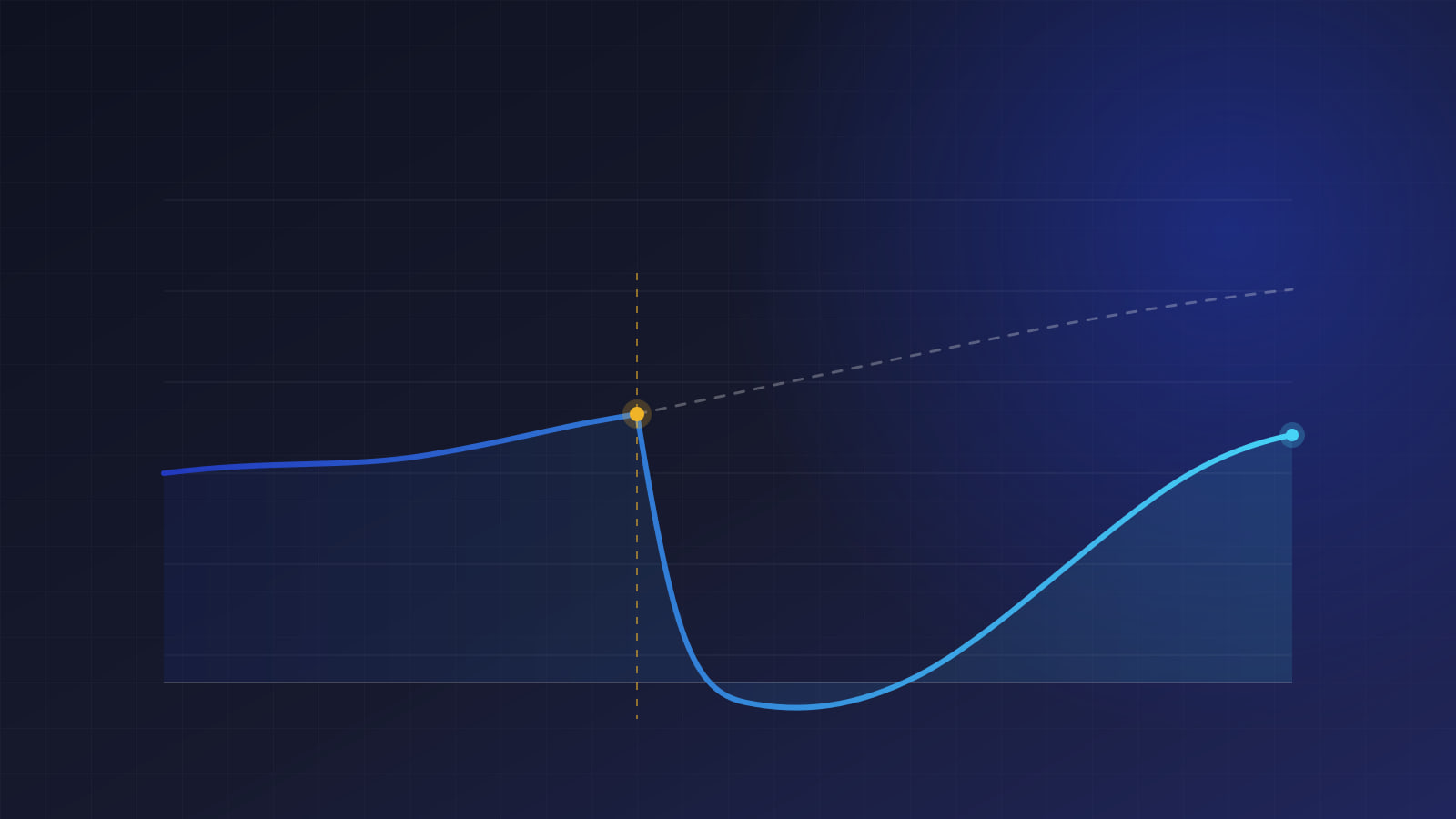
An account that was reaching 40,000 people a week reaches 4,000. Nothing obvious changed. There is no notification, no warning, no block. Just a number that fell over.
The word everybody reaches for is shadowban, and the internet has an enormous amount of confident advice about it, most of which amounts to "post less and use different hashtags". Some of that advice is right, for the minority of cases where suppression is what actually happened. Applied to the other cases, it does nothing except waste the two weeks in which the real problem was fixable.
So the useful skill is not knowing what to do about a shadowban. It is telling one apart from the four things that produce an identical-looking graph.
The four causes, in order of how common they are
1. The content changed and you did not notice
By far the most common, and the hardest to accept. Reach on short video is driven overwhelmingly by watch-through in the first two or three seconds. A change in editing style, a new intro, a slightly slower opening, a different aspect ratio that letterboxes on some devices. Any of these can halve reach with no penalty involved at all.
This one is diagnosable from the numbers you already have: if impressions fell but the ratio of impressions to followers on your best-performing recent post is still normal, the distribution mechanism is fine and the content is the variable.
2. A seasonal or platform-wide shift
Reach moves for everybody at once more often than people expect: a format being pushed, a format being de-prioritised, a holiday week, a change in what the feed favours. The test is trivial and almost nobody runs it: look at three other accounts in the same niche that you do not control. If they dipped in the same week, it is not about you.
3. An action block, which is not a shadowban
A block on following, liking or commenting reduces the engagement you generate, which reduces the engagement you receive, which reduces reach. It looks like suppression and is not. It is usually visible, in the form of an error message when you try to act, and it lifts on its own within a few days.
4. Actual content suppression
Real and much rarer than the discourse suggests. It happens when content is judged to sit near the edge of what the platform will distribute: borderline subject matter, recycled content from another platform with its watermark intact, engagement patterns that look purchased, or a run of posts reported by users.
The characteristic signature is specific: reach from non-followers collapses while reach from followers stays roughly normal. Your existing audience still sees you. Nobody new does.
The diagnostic sequence
An afternoon's work, in order. Stop at the first one that answers the question.
- Split reach by follower status. Every platform's own analytics exposes this. Followers steady, non-followers gone is the suppression signature. Both down proportionally is a content or seasonal problem.
- Check three accounts you do not control in the same niche, over the same weeks. A shared dip is a platform shift.
- Try to act. Follow somebody, leave a comment. An error message means an action block, and that is the whole explanation.
- Search for your own account and a recent hashtag from a signed-out browser or an unrelated account. Not appearing in results where you previously did is a strong suppression signal.
- Look at what changed in the two weeks before the drop. New editing template, new music source, a batch of reposted content, a change of person running the account. Something is always there, and it is usually the answer.
Running step five is easier when there is a record of who did what and when. Agencies that keep one, and it does not need to be sophisticated, only complete, find the cause in minutes rather than reconstructing it from memory. It is why we build a per-person session history into ALI rather than leaving the audit trail to whoever remembers to update the sheet. More on the surrounding process in the content workflow that survives your eleventh account.
If it is suppression, what actually helps
The advice here is genuinely boring, and the boring version is the one that works.
- Stop posting for 48 to 72 hours. Not a week, because a long silence is its own signal. Two or three days.
- Remove the likely cause. If there is reposted content with another platform's watermark, take it down. If a recent post is near a policy line, take that down too. This is the step that matters most and the one people skip because it means admitting which post it was.
- Come back with your safest, most obviously original content. Not your most ambitious. The goal for the first week back is to be unremarkable.
- Cut outbound actions to near zero for that week. No follow rounds, no comment campaigns.
- Rebuild over two to three weeks. Recovery is gradual and almost never a single day where everything returns.
What does not help, despite being everywhere: deleting and reuploading old posts, switching between personal and business accounts, changing your username, or using a hashtag-checking service. None of these has any observable effect, and the first is actively harmful because it discards a post's accumulated engagement history.
Preventing the next one
Three habits account for most of the difference between accounts that get suppressed and accounts that do not.
Do not repost content carrying another platform's marks. Downloaded video with a watermark burned in is the clearest single trigger there is, and it is trivially detectable.
Keep engagement earned. Bought engagement is detectable at the pattern level, not the account level, and its cost is not the money. It is that the account is then permanently associated with a network of accounts that also bought it.
Watch weekly, not monthly. A dip caught in week one is a two-week recovery. The same dip caught in week five is an account that has been training a distribution system on poor performance for a month, and that takes considerably longer to undo. The metrics worth that weekly look are covered here.
Common questions
How do I know if I am shadowbanned or if my content is just worse?
Split your reach by follower status in the platform's own analytics. Suppression has a specific signature: reach from non-followers collapses while reach from your existing followers stays roughly normal. If both fell by a similar proportion, distribution is working fine and the content is the variable.
How long does a shadowban last?
When the cause is removed, most accounts see reach begin returning within one to two weeks, and full recovery over two to four. If nothing has changed by week three, the original cause is probably still present, most often a post that was never taken down or a repost carrying another platform's watermark.
Does deleting old posts help lift a shadowban?
Only for the specific posts that caused it. Bulk-deleting content is a widely repeated remedy with no observable effect, and it costs you the engagement history of everything you delete. Remove the post that crossed a line; leave the rest alone.
Can changing hashtags fix a reach drop?
Rarely, and it is the first thing everybody tries. Hashtags account for a small and shrinking share of distribution on short video. If a specific hashtag has been restricted then using it can suppress an individual post, but that produces one bad post rather than a sustained collapse across an account.
Keep reading
 8 min read
How to Manage Multiple Instagram Accounts Without Getting Them Flagged
Running several accounts is not against the rules. Running them badly is what gets them restricted. Here is what actually links accounts together, and how to structure things so one problem stays one problem.
Read the article 7 min read
The Six Numbers Worth Looking At Every Week
Most dashboards show twenty-five numbers and answer no questions. Six of them tell you whether an account is actually working. Here they are, and what each one means when it moves.
Read the article 7 min read
The Content Workflow That Survives Your Eleventh Account
Almost every agency hits the same wall between the third account and the fifteenth. The work does not get harder. The coordination does. Here is the shape of a pipeline that holds.
Read the article